Do Kwon Sentenced to 15 Years in Prison for Orchestrating $40 Billion Crypto Fraud
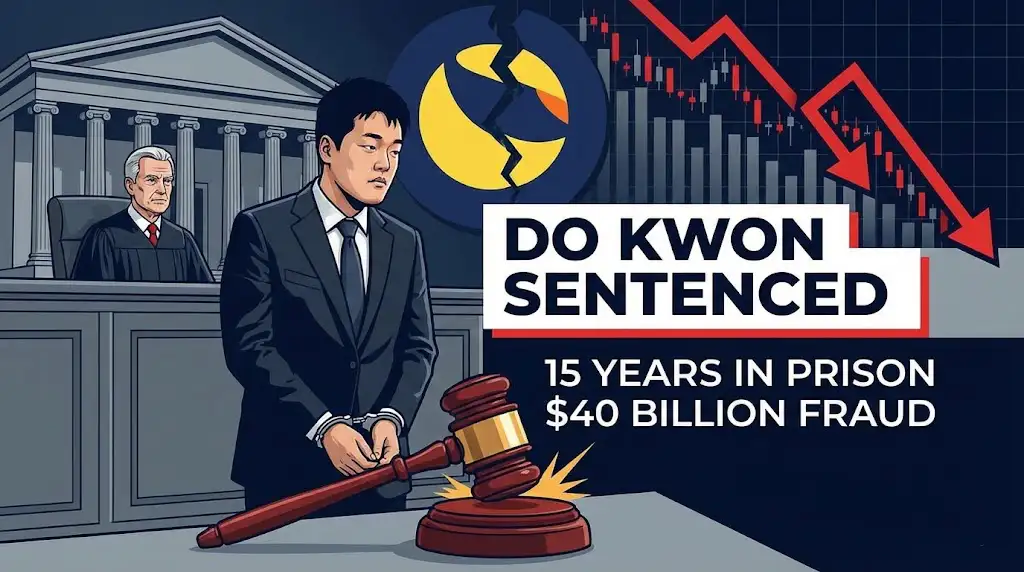
Do Kwon, the discredited co-founder of Terraform Labs and the creator of the algorithmic stablecoin ecosystem that cost investors $40 billion, has been sentenced to 15 years in federal prison.
U.S. District Judge Paul A. Engelmayer in the Southern District of New York gave the punishment on Thursday, December 11. It is the last chapter in one of the most heartbreaking stories in the bitcoin sector.
A Sentence “Stiffer” Than Requested
The 15-year sentence was longer than the 12-year sentence that federal prosecutors had requested for, which was a surprise. Kwon’s lawyers had asked for a far lesser sentence of only five years because he had never been in trouble with the law before.
Judge Engelmayer called the defense’s plea “wildly unrealistic” and said that Kwon’s activities were “fraud on an enormous, generational scale.”
“You created an almost mystical hold on your investors,” Judge Engelmayer told Kwon during the sentencing. “Reading some of their letters was like reading the words of cult followers. The human wreckage you have caused is incalculable.”
Kwon’s sentence ends a long-running legal fight between countries. After the TerraUSD (UST) and Luna tokens fell apart in May 2022, Kwon fled to Singapore and then to the Balkans. In March 2023, he was arrested in Montenegro for having fake travel papers.
The US and South Korea fought for a long time over Kwon’s return to the US. He finally got to the US on December 31, 2024.In August 2025, Kwon pleaded guilty to two counts of conspiracy to commit fraud and wire fraud. He took a plea deal in which he admitted to lying to investors about how stable the Terra algorithmic peg was and secretly using a third-party trading company to keep the value of the token up during a de-pegging event in 2021.
The court also told Kwon to give up $19.3 million in money he got through crime. This number is different from the $4.5 billion civil settlement Terraform Labs reached with the U.S. Securities and Exchange Commission (SEC) earlier in 2024. That settlement mostly paid back investors who had lost money by selling off the company’s remaining assets.
Kwon’s 15-year sentence puts him among the most severely punished people in the recent wave of crypto enforcement actions. However, he got less time than FTX founder Sam Bankman-Fried, who got 25 years in 2024.
Legal experts say that Kwon’s sentence is important because he pleaded guilty, while Bankman-Fried went to trial. The judge made it clear that Kwon didn’t steal money from customers directly like Bankman-Fried did, but his “algorithmic” lies caused just as much damage to the system and the market.
One interesting thing about Kwon’s plea deal is that it might let him serve the last half of his sentence in South Korea, where he was born.
The U.S. Department of Justice says that if Kwon follows all the rules of his plea and forfeiture, the U.S. will not stop him from being sent to Korean custody after he has served at least half of his time in an American federal prison. This concession shows that Kwon is still facing separate fraud charges in Seoul.